On 4 November 2026 Jyothy Labs did two things in one board meeting: it reported a quarter in which net profit fell 87.9% to ₹10.60 crore, and it approved a ₹147.00 crore buyback of its own shares at ₹215 each. Strip out treasury income and the company earned ₹75 lakh before tax on ₹760.04 crore of sales. This report traces both decisions to the pages they came from.
Source: Jyothy Labs Limited, board meeting outcome dated 4 November 2026, filed with BSE (scrip 532926) and NSE (JYOTHYLAB): 11 pages holding the limited review report, unaudited standalone results for the quarter and half year ended 30 September 2026, the pre-buyback shareholding pattern and the buyback particulars. Figures are as printed under the header "(₹ in Lakhs)". Conversions to crore are ours: 1 crore = 100 lakhs.
The 60-second read
- Profit before tax fell 86.2%, from ₹118.69 crore to ₹16.38 crore, while revenue rose 3.3% to ₹760.04 crore (page 5).
- Other income of ₹15.63 crore was 95.4% of the ₹16.38 crore profit before tax. The operating business cleared ₹75 lakh before tax (page 5).
- One line explains it. Materials, purchases and inventory movement together cost 65.2% of revenue, against 52.0% a year earlier: ₹113.39 crore of extra cost on ₹23.98 crore of extra sales (page 5).
- Operating cash flow for the half year was minus ₹12.83 crore, against plus ₹196.45 crore a year earlier, while ₹128.53 crore of dividend went out (page 8).
- The buyback uses 97% of the headroom a board can use alone. At 9.70% of capital and free reserves it sits just under the 10% board-approval limit, so no shareholder vote is needed (page 2).
- Promoters, at 62.88%, will not tender. Their stake rises to about 64.08% without buying a share, and the shares come from the other 37.12% (pages 2 and 10).
What they actually make
Jyothy Labs sells everyday household goods through three reported segments. The filing names products, not brands, so the wording below is the company's own, from page 9.
Fabric Care, ₹386.58 crore, 50.9% of revenue. Fabric whitener, enhancer and conditioner, detergent powder, liquid and bar soap, laundry services. Fabric whitener is the small bottle of blue liquid added to a bucket of washing to stop white clothes yellowing. Households buy it again every few weeks. Revenue grew 10.4%, the best of the three.
Home Care, ₹282.38 crore, 37.2%. Dishwash bar, gel, liquid, powder and scrubbers; mosquito coil, vaporiser, racquet and aerosol; toilet and floor cleaner, incense sticks and agarbatti. The dishwash bar is the hard green cake by the kitchen sink. This segment broke: revenue down 7.1%, and a ₹12.83 crore loss where a ₹39.48 crore profit stood a year ago.
Personal Care, ₹91.08 crore, 12.0%. Body soap, toothpaste, deodorants, talcum powder, after shave and hand wash. The smallest segment, and the only one whose profit rose, to ₹5.56 crore from ₹2.20 crore.
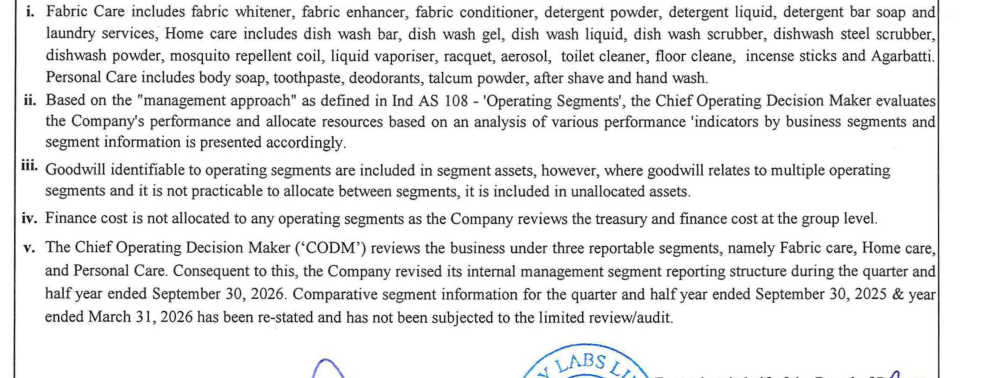
Why this matters. Note v says the company "revised its internal management segment reporting structure during the quarter", and that the restated comparatives for the year-ago quarter and FY26 have "not been subjected to the limited review/audit". The numbers you compare against are therefore unreviewed. Not wrong, but unexamined.
Read the rest of this report
The full report continues below - the figures, the numbers with their page references, and what the document does not say.
- Every figure traced to the page it came from
- Charts and tables taken straight from the document
- What the filing discloses about its own risks
- New reports every week, and on every mainboard IPO
Already subscribed? Sign in with the same Google account.
Information only. ForgeUp is not registered with SEBI as a Research Analyst or an Investment Adviser. This report is educational and informational, is based on the document named above, and is not a recommendation to apply for, buy, sell or hold any security. Figures are as stated in the source document and may be restated or superseded. Securities investment is subject to market risk; read all offer documents carefully. See our disclaimer.