
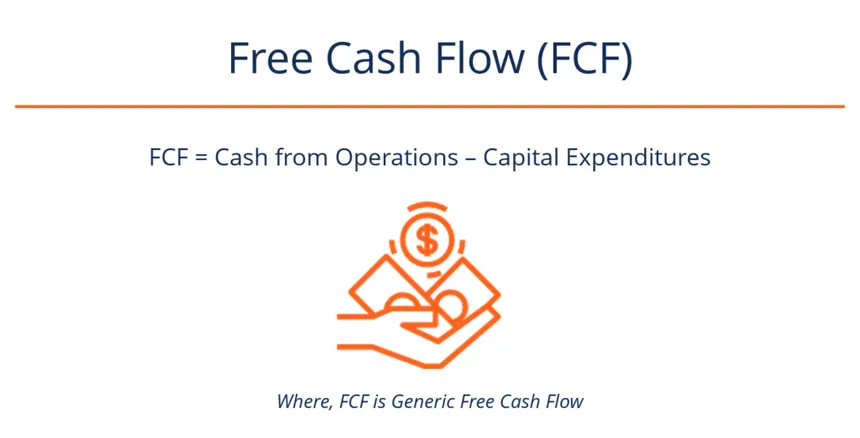
Free Cash Flow (FCF) is the actual cash a company has left over after paying all its operating expenses and spending money on capital assets like buildings, machinery, and technology. Unlike “Net Profit,” which is an accounting figure, FCF represents the real, cold hard cash available to be given back to shareholders or used to grow the business.+1
What Is Free Cash Flow: Formula, Meaning & Why It Matters More Than Net Profit in 2026
In the April 2026 Indian market, investors have become extremely cautious. With the Nifty 50 experiencing volatility due to global oil prices (Brent crude crossing $100 earlier this month) and the Rupee hovering around ₹92.85 per USD, “accounting profits” are no longer enough to impress the street. Today, seasoned investors and DIIs (Domestic Institutional Investors) look at Free Cash Flow to see if a company is truly “printing money” or just showing paper profits.+1
How is Free Cash Flow Calculated?
You can find the pieces of this puzzle in a company’s Cash Flow Statement. The most common way to calculate it is:
Free Cash Flow=Cash from Operating Activities−Capital Expenditures (CapEx)
The Two Main Types of FCF:
- FCFF (Free Cash Flow to the Firm): This is the cash available to everyone who has put money into the company, including both shareholders and the banks/lenders. It is used to find the total value of the business.
- FCFE (Free Cash Flow to Equity): This is the cash left over only for the shareholders after the company has paid back its loans and interest. This is the money that pays your dividends.+1
Why FCF Matters More Than Profit in 2026
You might ask, “If a company is making a profit, why do I need to check the cash?” Here is the reality of the 2026 market:
A. Cash is Harder to “Fake”
A company can use clever accounting to show a high Net Profit even if it hasn’t actually received any cash from its customers yet (Accrual Accounting). However, you cannot fake the cash in your bank account. FCF shows the real liquidity of the business.+1
B. Self-Funding Growth
In early 2026, borrowing money became expensive as global interest rates stayed high. A company with high Free Cash Flow can expand, build new factories, or buy smaller competitors using its own money instead of taking high-interest loans. This makes the company “future-proof.”
C. The Fuel for Dividends and Buybacks
Companies like Wipro and TCS have been in the news in 2026 for massive buybacks and dividends. These rewards are only possible if the company has positive FCF. If a company pays a dividend but has negative FCF, it is likely borrowing money to pay you—which is a major Red Flag.
Positive vs. Negative Free Cash Flow
| Status | What it Means | 2026 Market View |
|---|---|---|
| Positive FCF | The company is generating more cash than it spends on its growth. | Bullish. Seen as a sign of a “Cash Cow” or a stable, healthy business. |
| Negative FCF | The company is spending more on its assets/operations than it’s making. | Neutral/Bearish. Common in startups or companies in a “Heavy Capex” phase (like 2026 green energy firms). |
Note for 2026: Negative FCF isn’t always bad. If a company is spending heavily on Generative AI or Semiconductor plants (the big themes of 2026), it might have negative FCF today but massive profits in 2028. You must check where the cash is going.
The “FCF Yield” – A Secret Tool for Investors
In April 2026, analysts are using FCF Yield to find “cheap” stocks.
FCF Yield=Current Market Price/Free Cash Flow per Share
If a stock has an FCF yield of 8% while a Bank FD is giving you 7%, the stock is effectively “cheaper” and more rewarding than a fixed deposit.
Also read about How to Track Bulk & Block Deals in NSE
Summary: The 3-Step FCF Checklist
When you are researching a stock on Screener.in or Moneycontrol in 2026, follow these three steps:
- Check the Trend: Is the FCF growing over the last 3 to 5 years? Steady growth is better than a one-time spike.
- Compare with Net Profit: If Net Profit is ₹500 Cr but FCF is -₹100 Cr, the company might be struggling to collect money from its customers.
- Check the Capex: If FCF is low because the company is building a massive new factory that will double its capacity, it might be a great “Buy” opportunity.
Frequently Asked Questions(FAQ)
Can a company have a high profit but zero Free Cash Flow?
Yes. This often happens in businesses that give too much “credit” to customers (High Accounts Receivable) or companies that have to spend all their profit just to maintain their old, aging machinery (High Maintenance Capex).
Is negative Free Cash Flow always a red flag?
Not necessarily. Rapidly growing young companies (like EV startups in 2026) often have negative FCF because they are investing every rupee into building their infrastructure. It only becomes a red flag if the company is old and still hasn’t turned “Cash Positive.”
Where can I find FCF in a company’s report?
Go to the Cash Flow Statement. Take the “Net Cash from Operating Activities” and subtract “Purchases of Fixed Assets” (found in the Investing Activities section).
Conclusion
Free Cash Flow is the ultimate “truth-teller” in the Indian stock market. While profit is an opinion, cash is a fact. In the volatile environment of 2026, companies with strong, positive Free Cash Flow are the ones that survive global shocks, pay consistent dividends, and grow without falling into a debt trap. Before you buy any stock, always look past the “Earnings Per Share” (EPS) and ask: “Where is the cash?”
Disclaimer: The views expressed are for informational purposes only and do not constitute financial advice. Investing in stocks and IPOs involves significant risk.
forgeup.in is not liable for any financial losses. Always consult a certified investment advisor before making any decisions.