
Reliance Industries vs. Tata Group: The corporate landscape of India has long been dominated by two towering configurations: the Tata Group, a sprawling salt-to-software legacy conglomerate built on institutional trust and multi-generation cross-holdings, and Reliance Industries Limited (RIL), a hyper-aggressive, scale-driven oil-to-retail empire masterminded by Mukesh Ambani. Together, these two corporate giants have shaped nearly every major sector of the Indian economy.
As of May 2026, this historic rivalry has transformed into a high-stakes clash. No longer confined to their traditional territories—where Tata managed software, steel, and autos while Reliance dominated oil refining and petrochemicals—the two giants are facing off directly in new sectors. From e-commerce and retail ecosystems to electric vehicles, green hydrogen, and advanced semiconductor manufacturing, the battle lines are firmly drawn.
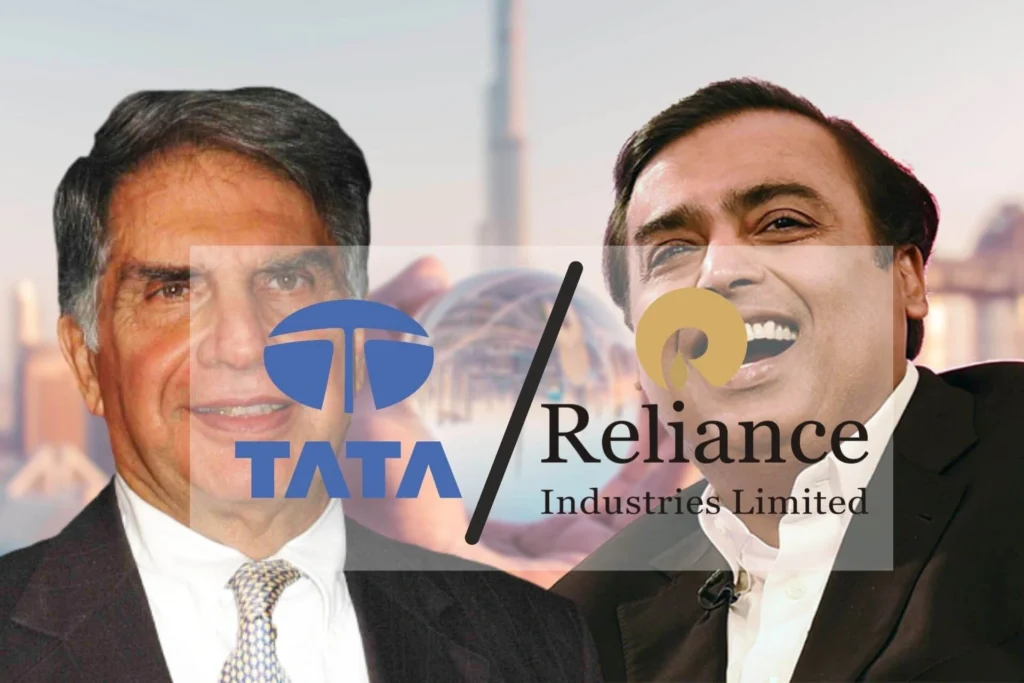
Reliance Industries vs. Tata Group 2026: Who’s Leading India’s Biggest Corporate Battle in Revenue, EVs & Tech?
The Financial Scorecard: Unprecedented Scale
The audited full-year financial closures for FY26 (ended March 31, 2026) reveal two distinct corporate models operating at peak financial performance, achieving historic revenue milestones.
Financial Performance Comparison (FY26 Consolidated Data)
| Metric | Reliance Industries Limited (RIL) | Tata Group (Aggregate Core Entities) |
| Annual Revenues | ₹11,75,919 Crore ($124 Billion) | ~$165 Billion (Estimated Group Total) |
| Consolidated EBITDA | ₹2,07,911 Crore | Strong operational cash across TCS, Tata Motors, and Tata Steel |
| Net Profit (PAT) | ₹95,754 Crore ($10.1 Billion) | Driven by TCS (₹48,000+ Cr) and recovering domestic units |
| EBITDA Margin Profile | 17.8% | ~25.3% in IT Services; compressed in global luxury auto lines |
RIL’s Single-Entity Dominance
In May 2026, Reliance announced that it has become the first Indian corporate entity in history to cross $120 billion in annual revenue and $10 billion in absolute annual net profit. Strikingly, RIL’s net profit exceeds the combined net incomes of India’s top three IT majors, driven by its retail, telecom, and oil-to-chemicals (O2C) segments.
Tata’s Distributed Brand Premium
While RIL functions as a single listed entity, the Tata Group derives its strength from its distributed corporate layout. The Brand Finance India 100 report (released April 2026) crowned the Tata Group as India’s most valuable corporate brand at $31.6 Billion, comfortably pacing ahead of RIL’s independent brand valuation of $9.8 billion.
Sector Face-Off: The Core Strategic Arenas
A. Digital Services & Telecom Disruption
- Reliance Jio: Jio consolidated its absolute monopoly in the digital ecosystem, with its FY26 net profit jumping 15.1% to cross ₹30,000 Crore. This growth was driven by widespread 5G adoption, rising Average Revenue Per User (ARPU), and fixed-line broadband scale. Investors heading into the upcoming Reliance AGM on June 19, 2026, are highly focused on updates regarding the Jio IPO.
- Tata’s Tech Countermeasure: Tata avoids mass telecommunication distribution, choosing instead to focus on enterprise technology. Tata Consultancy Services (TCS) kicked off the year by posting a strong Q4 FY26 revenue of ₹70,698 Crore, driving its operating margins to a 4-year high of 25.3%. TCS expanded its market share by embedding artificial intelligence deep into enterprise frameworks, generating a massive $2.3 Billion annualized AI service run-rate.
B. Retail Omnichannel Wars
The battle for the wallets of India’s consumers has evolved into an intense omnichannel race:
- Reliance Retail Ventures: Annual profits neared ₹14,000 Crore (+11.7% YoY). Capitalizing on its massive physical footprint, Reliance focused its FY26 execution on hyper-local e-commerce integration, successfully onboarding rural cohorts via access-priced digital channels.
- Tata Neu & Premium Acquisitions: Tata responded by leveraging its Tata Neu Super App ecosystem, meanwhile stitching together BigBasket, 1mg, Westside, and Croma. Tata has focused on premiumization, furthermore dominating online grocery, high-end fashion, and corporate enterprise tech integrations to counter Reliance Industries’ mass-market strategy.
C. The New Energy & EV Horizon
The most significant long-term structural face-off is occurring within the green energy transition:
- Tata’s EV Domination: Through Tata Motors Passenger Vehicles (TMPVL), the group achieved its highest-ever annual sales of over 6.4 lakh units, driven by its undisputed leadership in electric passenger cars. More significantly, the business recorded a milestone EV volume of over 92,000 units in FY26, capturing a near-monopoly in India’s electric car segment.
- Reliance’s Greenfield Hydrogen Infrastructure: Rather than building consumer EVs, Reliance is focusing on upstream green infrastructure. At its mega-complex in Jamnagar, RIL is investing billions to commercialize localized Gigafactories for photovoltaic solar panels, energy storage batteries, and green hydrogen electrolyzers, aiming to become the lowest-cost producer of clean energy substrates in emerging markets.
Advanced Technology: The Semiconductor Frontier
A defining shift in the 2026 rivalry is the race to build India’s semiconductor infrastructure. The Tata Group has taken a decisive first-mover advantage here. Through Tata Electronics, the group initiated construction on its massive ₹91,000-crore commercial semiconductor fabrication plant in Dholera, Gujarat, alongside a secondary assembly and testing unit in Jagiroad, Assam.
By manufacturing domestic microchips for global automotive, computing, and defense clients, Tata is building an advanced technological moat. Reliance, while actively building out its automated AI cloud supercomputing data centers via Jio, is forced to watch Tata lead this high-barrier hardware manufacturing curve.
Also read about: Fundamental Analysis of ICICI Prudential AMC
Key Strategic Risks: The Vulnerability Matrix
- Reliance’s Geopolitical and Margin Overhead: Over 45% of RIL’s earnings remain anchored to its traditional Oil-to-Chemicals (O2C) sector. Ongoing geopolitical conflicts in the Middle East and maritime shipping bottlenecks expose RIL to volatile crude price spreads. Given this exposure, the firm must continuously transition its cash profits into consumer verticals to sustain its valuation.
- Tata’s International Subsidiary Friction: While Tata’s domestic operations are thriving, its international assets introduce financial headwinds. In its latest audited earnings report, Tata Motors noted that its full-year profitability was impacted by headwinds at Jaguar Land Rover (JLR), including cyber incidents, luxury tax adjustments in China, and adverse global commodity cycles. These challenges left consolidated net debt at ₹30,700 crore.
Valuation Stance & Market Capitalization
| Corporate Group | Market Valuation Stance (May 2026) | Primary Valuation Anchor |
| Reliance Industries | ~₹21.2 Lakh Crore Single-Entity Cap | Premium consumer growth multiples applied to Jio and Retail. |
| Tata Group | ~₹32.8 Lakh Crore Aggregate Cluster | Anchored by TCS, Tata Motors, and the structural asset turnaround at Tata Steel. |
Frequently Asked Questions
Why did Reliance Industries’ net profit jump by 17.8% in FY26?
The record expansion to ₹95,754 crore ($10.1 Billion) driven by robust double-digit growth within its digital services (Jio) and retail operations, alongside strong operational efficiencies captured in its O2C processing lines. This allowed RIL to become the first Indian company to surpass the $10 billion annual profit milestone.
What caused the margin squeeze observed at Tata Motors in FY26?
While domestic passenger and electric vehicle volumes hit record highs, consolidated full-year profitability was weighed down by headwinds at JLR. These challenges included shipping container delays, cyber incidents, and luxury tax adjustments inside Chinese distribution channels, which raised net debt to ₹30,700 crore.
How are the two conglomerates approaching the artificial intelligence space?
Tata is focusing heavily on software execution, with TCS establishing a $2.3 Billion annualized AI service run-rate by embedding generative AI into global enterprise tech frameworks. Meanwhile, Reliance is focusing on infrastructure, leveraging Jio’s networks to construct low-cost, high-density AI cloud processing data centers to serve the mass domestic consumer market.
Conclusion
The direct confrontation between Reliance Industries and the Tata Group in 2026 is reshaping India’s industrial landscape.
Reliance operates as a hyper-centralized, highly agile capital-allocator. Under Mukesh Ambani’s guidance, the corporate machine can therefore shift billions into new digital and retail platforms overnight, using the steady cash flows from its massive refining assets to disrupt established markets.
Conversely, the Tata Group operates as an expansive corporate republic. It draws structural strength from individual listed champions like TCS and Tata Motors.
For institutional portfolio construction, the two giants offer complementary strengths. Reliance provides a high-yielding, mass-market consumer and digital engine, while the Tata Group offers a premium, high-governance proxy on global enterprise AI, domestic electric vehicles, and next-generation semiconductor hardware fabrication. As India marches toward its goal of becoming a developed economy, the collaborative and competitive execution of these two corporate titans remains the primary engine driving national wealth creation.
Disclaimer: The views expressed are for informational purposes only and do not constitute financial advice. Investing in stocks and IPOs involves significant risk.
forgeup.in is not liable for any financial losses. Always consult a certified investment advisor before making any decisions.