
Relative Strength Index (RSI) is a momentum oscillator used in technical analysis that measures the speed and change of price movements. It oscillates on a scale of 0 to 100 and is primarily used to identify overbought or oversold conditions in an asset, helping traders decide when to buy or sell. Developed by J. Welles Wilder in 1978, the RSI remains one of the most popular technical indicators in 2026. Whether you are trading stocks, forex, or crypto, the RSI provides a visual “thermometer” for market sentiment, showing whether the bulls (buyers) or bears (sellers) are currently in control.

What Is Relative Strength Index (RSI)? Formula, Levels & Trading Strategies Explained
How Does Relative Strength Index (RSI) Works? (The 70/30 Rule)
The RSI is typically displayed as a line graph moving between two horizontal boundaries. In its standard configuration, the most critical levels are 70 and 30.
- Overbought (Above 70): When the RSI crosses above 70, it suggests that the asset has risen too quickly and may be “overbought.” This is often a warning that the price might be due for a correction or a reversal.
- Oversold (Below 30): When the RSI falls below 30, it indicates that the asset has dropped significantly and may be “oversold.” Traders often see this as an opportunity to buy, as the price might be due for a bounce.
- Neutral (Midpoint 50): The 50 level acts as a separator. An RSI above 50 generally indicates bullish (upward) momentum, while an RSI below 50 indicates bearish (downward) momentum.
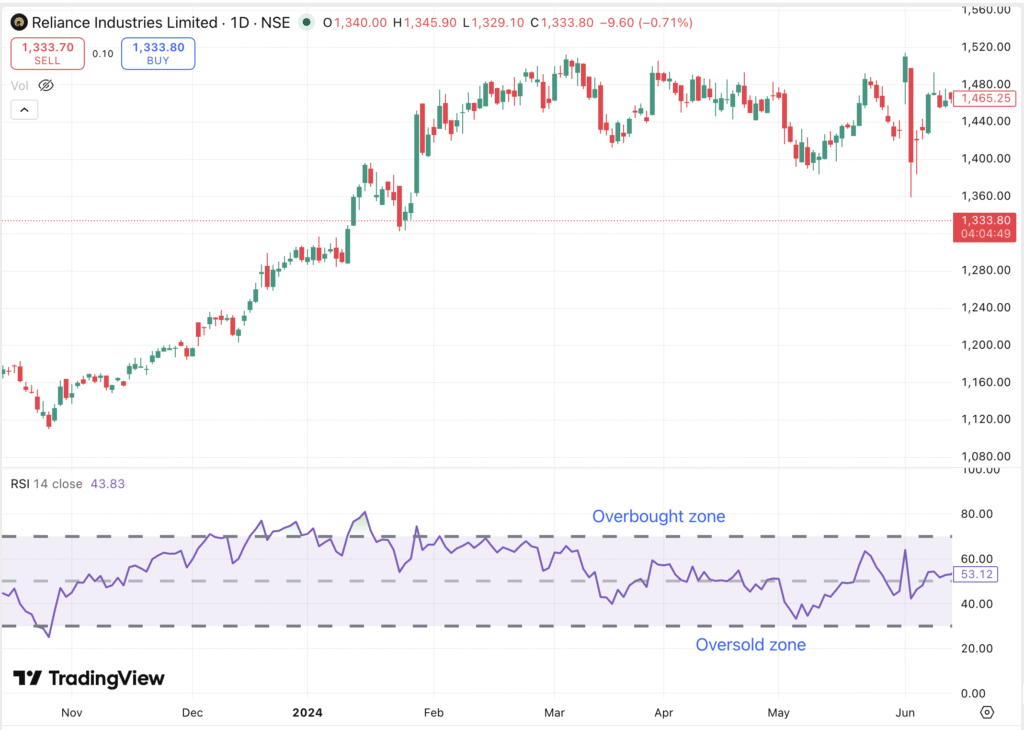
The Relative Strength Index (RSI) Formula and Calculation
The RSI calculation is a two-step process that compares the average gains and average losses over a specific period (usually 14 days or periods).
The Basic Formula:
RSI = 100 – (100/1 + RS)
Where RS (Relative Strength) is:
$$RS = Average Gain during Up Periods/Average Loss during Down Periods
For example: If over the last 14 days, a stock had an average gain of 2% on up days and an average loss of 1% on down days, the RS would be 2. Plugging that into the formula:
RSI = 100 – (100/1 + 2) = 100 – 33.33= 66.67
This indicates moderately strong bullish momentum, as the RSI is approaching the 70 overbought mark.
Key Trading Strategies Using Relative Strength Index (RSI)
In 2026, traders use RSI for more than just simple overbought/oversold signals. Here are the advanced techniques:
A. Divergence (The Reversal Signal)
Divergence occurs when the price of a stock moves in the opposite direction of the RSI. This is one of the most powerful signals of a coming trend change.
- Bullish Divergence: The stock price makes a lower low, but the RSI makes a higher low. This suggests that selling pressure is fading even though the price is still dropping.
- Bearish Divergence: The stock price makes a higher high, but the RSI makes a lower high. This suggests that the upward move is losing steam.
B. RSI 50-Level Crossover
Traders often use the center line (50) to confirm a trend. If the price is trending up and the RSI crosses from 40 to above 50, it confirms that the bulls are gaining strength. Conversely, dropping below 50 confirms a bearish shift.
C. Failure Swings
A failure swing happens when the RSI enters an extreme zone (above 70 or below 30) but fails to confirm the price trend.
- Top Failure Swing: RSI goes above 70, drops below a previous “trough,” and then fails to make a new high. This is often a sell signal.
Also read about What Happens to Shares During a Company Merger in 2026
Optimal Settings for 2026 Trading using Relative Strength Index (RSI)
While the default setting is 14 periods, modern traders often adjust the RSI based on their style:
- Day Traders / Scalpers: Often use a shorter 9-period or 7-period RSI to get more frequent (though riskier) signals.
- Swing Traders: Generally stick to the 14-period RSI for a balance of speed and reliability.
- Extreme Volatility (Crypto): Some traders adjust levels to 80/20 instead of 70/30 to filter out the high “noise” of volatile markets.
Frequently Asked Questions(FAQ)
Can RSI predict a stock crash?
RSI can signal that a stock is “exhausted” through Bearish Divergence or staying above 70 for too long. However, a high RSI does not mean a crash is guaranteed; it simply means the risk of a correction has increased.
What is a “good” RSI level to buy?
Conventionally, an RSI below 30 is a buy signal. However, in a strong uptrend, many traders look to buy when the RSI dips to 40 or 50, as the stock rarely falls all the way to 30 during a healthy bull run.
Does RSI work for intraday trading?
Yes, RSI is widely used in intraday trading. However, on shorter timeframes (like 1-minute or 5-minute charts), the 14-period setting might be too slow. Many intraday traders prefer a 9-period RSI for faster responses.
Conclusion
The Relative Strength Index (RSI) is an essential tool for understanding the internal “engine” of a stock’s price action. While it is incredibly helpful for spotting reversals and measuring momentum, it should rarely be used alone. In 2026, the most successful traders combine RSI with Volume and Moving Averages to confirm their entries. Remember that in strong trending markets, the RSI can stay overbought or oversold for a long time—so never sell just because the RSI hits 70; wait for the trend to actually show signs of breaking.
Disclaimer: The views expressed are for informational purposes only and do not constitute financial advice. Investing in stocks and IPOs involves significant risk.
forgeup.in is not liable for any financial losses. Always consult a certified investment advisor before making any decisions.