
Market Capitalization is the total value of a company’s shares on the stock market. When it comes to Large Cap Mid Cap And Small Cap categories in India, LargeCaps are the top 100 giants, MidCaps are the next 150 growing firms (101–250), and SmallCaps are all companies ranked 251st and beyond. If you are stepping into the Indian stock market in April 2026, you are entering a landscape where the Nifty 50 is trading near 24,292 and the Sensex is at 78,254. To navigate this territory, you must understand the “weight classes” of stocks. Just as a heavyweight boxer has different strengths and risks compared to a featherweight, Large Cap Mid Cap And Small Cap stocks offer vastly different journeys for your money.
In 2026, these categories have been redefined by the Association of Mutual Funds in India (AMFI) to account for the massive surge in market valuations. Understanding these shifts is the key to building a balanced portfolio that doesn’t collapse during a market correction.
Large Cap Mid Cap And Small Cap: Which One Is Actually Right for You in 2026?
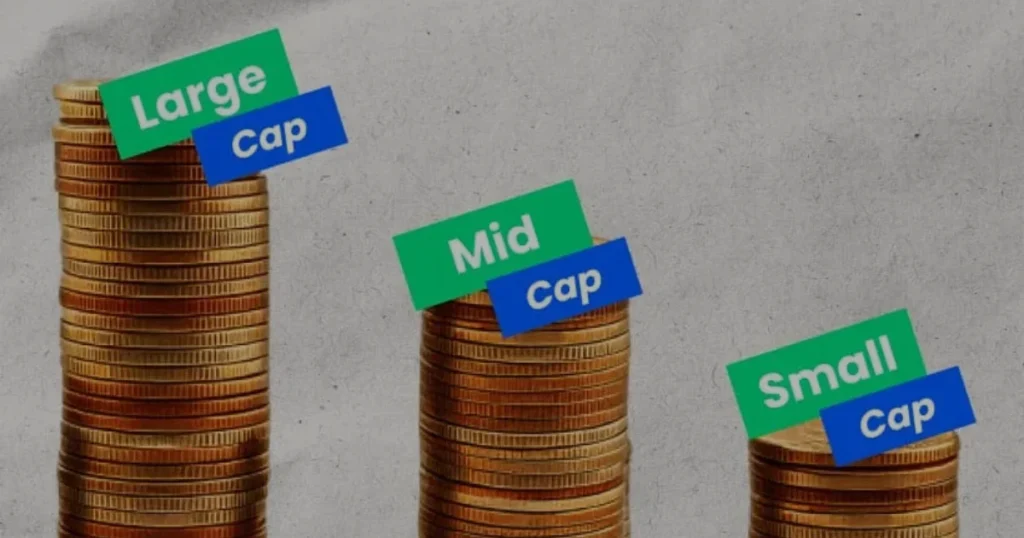
LargeCap Stocks: The Market Anchors
Large-cap companies are the “Blue Chip” legends of the Indian corporate world. These are the household names you see every day—the banks where you keep your money, the companies that provide your internet, and the giants that build our national infrastructure.
The 2026 Definition
As of the January 2026 AMFI reclassification, a company must have a six-month average market capitalization of at least ₹1,05,000 crore to be considered a LargeCap. This is a significant jump from previous years, reflecting the growth of the Indian economy.
Key Characteristics:
- Stability: These are the least volatile stocks. When the market crashes, these “anchors” usually fall the least.
- Institutional Favorites: Foreign Institutional Investors (FIIs) and Life Insurance Corporation (LIC) primarily invest here because these stocks offer high liquidity (you can buy or sell crores worth of shares without moving the price).
- Dividends: Since these companies are already huge, they often distribute their extra profits to shareholders as dividends rather than reinvesting everything into growth.
Current 2026 Examples: Reliance Industries, TCS, HDFC Bank, and newly elevated giants like Hero Motocorp and Muthoot Finance.
MidCap Stocks: The High-Growth All-Rounders
Mid-cap stocks are often described as the “sweet spot” of investing. These are companies that have successfully moved past the risky “startup” phase and are now aggressively fighting to become the next Reliance or TCS.
The 2026 Definition
Mid-cap stocks are those ranked from 101 to 250 in terms of market value. In 2026, the market cap range for this category typically falls between ₹34,700 crore and ₹1,05,000 crore.
Key Characteristics:
- The Transition Phase: The biggest wealth in the stock market is often made when a MidCap company grows into a Large Cap.
- Moderate Volatility: They are riskier than LargeCaps but offer much higher growth potential. In a “bull market” (rising market), MidCaps often outperform the Nifty 50.
- Sector Leaders: Many MidCaps are leaders in niche industries, such as specialized electronics manufacturing (Dixon Technologies) or high-end hospitality (Indian Hotels).
Current 2026 Examples: Coforge, Astral, and companies recently shifted from the LargeCap bucket like Havells India and Mankind Pharma.
SmallCap Stocks: The Potential Multibaggers
Small-cap stocks are the smallest listed companies. This is where “Multibagger” dreams are born—and where many retail investors lose their capital if they aren’t careful.
The 2026 Definition
Any company ranked 251st and beyond on the stock exchange is a SmallCap. In 2026, this usually means any company with a market cap below ₹34,700 crore. Some can be as small as ₹500 crore.
Key Characteristics:
- Massive Growth Potential: A small company can double its revenue much faster than a giant. This can lead to 10x or even 50x returns over a decade.
- Extreme Volatility: These stocks can drop 10% in a single day or 50% in a month. They are highly sensitive to bad news or a “liquidity crunch.”
- Low Liquidity: Sometimes, there are no buyers for a SmallCap stock during a crash, meaning you could be stuck with the shares even if you want to sell.
Current 2026 Examples: Niche software players, regional sugar mills, and emerging green energy startups.
Comparing the Three: 2026 Analysis Table
To help you decide where to put your money, here is how these three compare across critical factors in the current market environment:
| Feature | LargeCap | MidCap | SmallCap |
| SEBI/AMFI Rank | 1 – 100 | 101 – 250 | 251+ |
| Risk Level | Low | Moderate | High to Very High |
| 2026 Min. Cap | > ₹1,05,000 Cr | ₹34,700 Cr – ₹1.05 L Cr | < ₹34,700 Cr |
| Volatility | Steady | Active | Wild |
| Ease of Selling | Instant | Easy | Can be difficult |
| Information | Abundant Research | Moderate Research | Very Little Research |
| Investor Profile | Conservative | Growth-Seeking | Aggressive |
Risk and Reward: The “Real Talk” for 2026
The Indian market in 2026 is witnessing a unique trend where Index Funds (which track LargeCaps) are seeing record inflows, while SmallCap Mutual Funds are facing stricter “Stress Tests” by SEBI.
- LargeCaps are for those who want to beat inflation (getting 12-14% returns) while keeping their money safe.
- MidCaps are for those who can handle a 20-30% dip occasionally for the chance of 18-20% long-term returns.
- SmallCaps are for those who have a “long-term” vision (10+ years) and the stomach to watch their portfolio value fluctuate wildly.
Strategic Tip: In 2026, with global volatility due to West Asia tensions, experts suggest a Core and Satellite approach. Keep 60-70% of your money in “Core” LargeCaps for safety and 30% in “Satellite” Mid and SmallCaps for that extra growth boost.
Also read about Difference Between Intraday and Delivery Trading
How to Identify the Right “Cap” for Your Age
In the 2026 investment landscape, your age often dictates your allocation:
- Age 20–35: You have time on your side. You can afford a higher allocation (up to 40-50%) in Mid and Small Caps to maximize wealth creation.
- Age 35–50: You likely have responsibilities like home loans or children’s education. A balanced “50-30-20” rule (50% Large, 30% Mid, 20% Small) is often recommended.
- Age 50+: Focus on capital preservation. Move 70-80% of your equity portfolio into Large Caps or Dividend-yielding stocks to ensure your retirement fund stays stable.
Frequently Asked Questions(FAQ)
Which category is best for a SIP in 2026?
For a Systematic Investment Plan (SIP), Flexi-Cap funds are often the best choice for a normal man. These funds allow professional managers to automatically shift money between Large, Mid, and SmallCaps based on which one is currently “cheaper” and safer.
Why did SEBI increase the market cap cutoffs in 2026?
The cutoffs are updated twice a year by AMFI. As the total value of the Indian stock market grows, the “average” size of companies increases. To keep the top 100 as “LargeCap,” the minimum value must be raised to reflect the new market reality.
Are Small Cap stocks “cheap” because their price is low?
No. A stock’s “Cap” category is based on the total value of the company (Price $\times$ Total Shares), not the price of a single share. A stock priced at ₹10 could be a LargeCap, while a stock priced at ₹5,000 could be a SmallCap. Always look at the Market Cap, not the share price.
Conclusion
The difference between Large, Mid, and SmallCap stocks is essentially the trade-off between safety and speed. LargeCaps offer the safety of a heavy ship in a storm, while SmallCaps are like speedboats—fast but easily capsized by a big wave.
In 2026, the thresholds have moved higher, but the logic remains the same: diversify across all three based on your goals. Never put all your eggs in the SmallCap basket just because you heard a “hot tip,” and never ignore SmallCaps entirely, as they are the source of tomorrow’s wealth.
Disclaimer: The views expressed are for informational purposes only and do not constitute financial advice. Investing in stocks and IPOs involves significant risk.
forgeup.in is not liable for any financial losses. Always consult a certified investment advisor before making any decisions.