
The Indian banking sector is anchored by two massive institutions: the State Bank of India (SBI), a public-sector giant functioning as the nation’s financial backbone, and HDFC Bank Limited, a private-sector titan representing institutional retail credit design. Together, these two heavyweights SBI vs. HDFC Bank govern over one-third of India’s systemic credit and deposit networks.
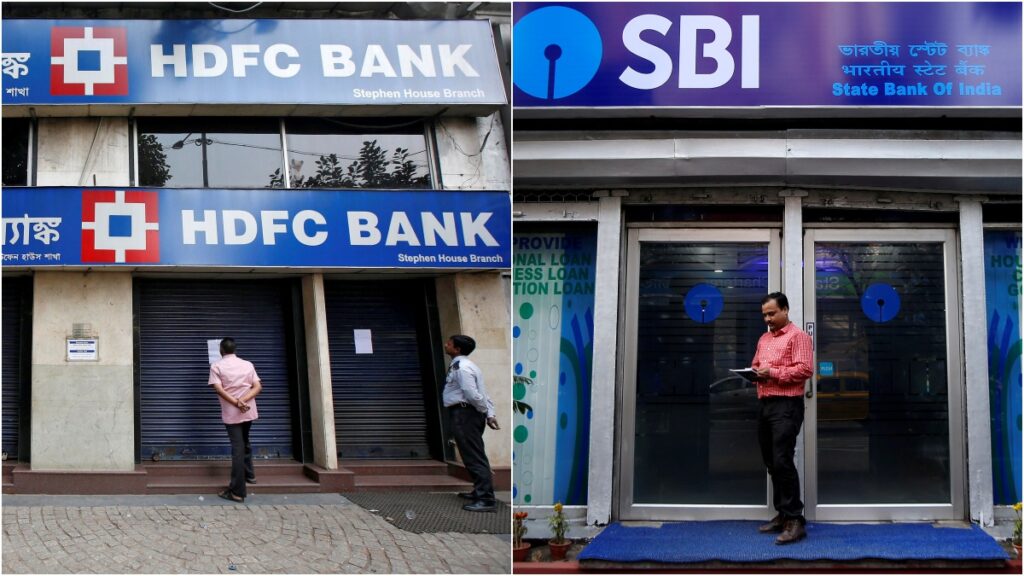
Following their recent Q4 FY26 audited earnings releases, the dynamic between public and private banking has reached a turning point. SBI has achieved an unprecedented level of profitability, while HDFC Bank is navigating a strategic, post-merger liquidity stabilization phase.
1. The Financial Scorecard: The ₹80,000 Crore Milestone
The audited results for the financial year ended March 31, 2026, show a surprising shift. The public-sector leader has officially outpaced the largest private lender in full-year core profitability.
Consolidated Financial Performance (Full Year FY26 Close)
| Performance Metric | State Bank of India (SBI) | HDFC Bank Limited |
| Gross Advances (Loan Book) | ₹49.32 Lakh Crore | ₹29.60 Lakh Crore |
| Total Deposits Base | ₹59.75 Lakh Crore | ₹31.05 Lakh Crore |
| Full Year Standalone PAT | ₹80,032 Crore (+12.8% YoY) | ₹75,120 Crore (Estimated FY Total) |
| Q4 FY26 Standalone PAT | ₹19,684 Crore | ₹19,221 Crore |
| Net Interest Margin (NIM %) | 2.91% | 3.38% |
| Return on Assets (ROA) | 1.12% | 1.96% |
Decoding the Operational Shift
The standout data point of May 2026 is SBI’s standalone annual net profit crossing the landmark ₹80,000 Crore threshold for the first time in corporate history. Backed by credit expansion across corporate and SME segments (+16.87% advances growth), SBI delivered a standalone PAT of ₹19,684 crore in Q4, beating out HDFC Bank’s quarterly profit of ₹19,221 crore.
However, from an efficiency perspective, HDFC Bank remains ahead. Its Return on Assets (ROA) sits at a premium 1.96% (approaching its historical 2.0% comfort zone), comfortably pacing ahead of SBI’s public-sector-leading ROA of 1.12%. This highlights that while SBI commands a much larger absolute balance sheet base, HDFC Bank extracts significantly higher net income per unit of asset deployed.
2. Core Operational Battles: The Credit-to-Deposit Squeeze
The defining challenge for Indian banking is a systemic structural gap: national loan expansion has consistently outpaced core deposit mobilization. The strategies deployed by these two giants to navigate this friction outline two different risk management styles.
A. The Credit-to-Deposit Ratio (CDR) Overhang
- HDFC Bank’s Post-Merger Diet: Following its mega-merger with HDFC Limited, the private lender’s loan-to-deposit ratio spiked to an uncomfortable high of nearly 99% in early fiscal cycles. Management has spent the past year executing a strict, deliberate credit calibration, intentionally matching fresh loan distributions to structural deposit additions. Driven by a massive ₹2.45 Lakh Crore deposit collection in Q4 alone, HDFC Bank has systematically lowered its operational CDR toward normalized systemic baselines.
- SBI’s Liquidity Buffer: Free from major organizational modifications, SBI operates with an incredibly comfortable Credit-to-Deposit ratio of 72% to 74%. This vast liquidity buffer allows the public sector major to aggressively target a 13% to 15% loan growth guidance for FY27 without facing immediate liquidity or funding stress.
B. Low-Cost Deposit Moats (CASA Ratio)
The competition for retail, low-cost checking and savings accounts remains intense:
- SBI CASA Ratio: Settled at an impressive 39.46%, supported by its unassailable sovereign status and deep branch networks across rural and semi-urban landscapes.
- HDFC Bank CASA Ratio: Stood at a competitive 38.2%, relying heavily on automated corporate salary accounts and modern wealth management platforms.
3. Technology and Asset Quality Moats
A. Digital Monetization Architecture
SBI’s YONO Platform has evolved into a premier consumer acquisition engine. Under Chairman CS Setty, the platform serves over 7.5 crore registered digital consumers, processing over 65% of all new saving account originations. Additionally, the bank is setting up a new advanced cybersecurity center to secure its digital footprint.
HDFC Bank’s Enterprise Transformation is yielding strong returns. Having successfully upgraded its backend tech infrastructure under its core digital overhaul programs, HDFC Bank handles over 95% of its payment, retail loan, and merchant transactions end-to-end digitally. Its specialized app formats, like SmartHub Vyapar, have significantly strengthened its corporate and SME merchant network.
B. World-Class Credit Underwriting
Both financial heavyweights maintain top-tier asset quality, proving that Indian banking has completely cleared out its legacy bad-debt overhang loops:
- SBI Asset Quality: Its Gross Non-Performing Asset (GNPA) ratio tracked beautifully down to 1.49%, while its Net NPA fell to a historic low of 0.39%, supported by tight risk monitoring across corporate exposures.
- HDFC Bank Asset Quality: Maintained its status as a global gold standard, with its Gross NPA fall to a pristine 1.15% and Net NPA tracking down to an elite 0.38%, outperforming the private banking peer group.
4. Valuation Analysis: The Convergence of Price-to-Book Multiples
The stock market performance highlights a major, long-term shift in investor sentiment, resulting in a rare narrowing of the valuation gap between public and private banking networks.
Comparative Market Multiples
| Valuation Parameter | State Bank of India (SBIN) | HDFC Bank Limited (HDFCBANK) |
| Current Stock Price | ~₹1,010.90 (Post-earnings correction) | ~₹744.75 (Consolidating base) |
| Trailing P/E Ratio (TTM) | 10.9x | 15.8x |
| Price-to-Book (P/B) Ratio | ~1.55x | ~2.1x |
| Full Year Equity Rewards | Declared a premium ₹17.35 dividend | Declared a final dividend of ₹13 |
| Dividend Record Timeline | Record Date passed (May 16, 2026) | Record Date set for June 19, 2026 |
5. Strategic Verdict: The Income Shield vs. The Compounding Engine
The choice between SBI and HDFC Bank in May 2026 comes down to portfolio composition goals:
State Bank of India represents an elite, high-yield value engine at peak operational performance. At a trailing P/E of just 10.9x and a healthy 18.57% Return on Equity (ROE), the public sector titan offers an immense margin of safety. Driven by an ₹80,032 crore annual net profit, a comfortable 72% loan-to-deposit ratio, and a premium ₹17.35 dividend payout, SBI is an exceptionally stable cash cow. It is built to deliver steady outperformance as its corporate and agricultural loan pipelines expand.
Conversely, HDFC Bank remains the premier private-sector compounding asset trading at an attractive structural discount. Historically valued at high book premiums, the private lender is currently trading at a compressed 2.1x Price-to-Book multiple, reflecting a temporary merger-stabilization phase.
As its deposit mobilization engine matches its credit framework, its premium 1.96% ROA operating leverage will naturally re-engage. For patient, structural portfolios, accumulating HDFC Bank at its current support bands offers an exceptional risk-reward window to capture massive upside returns as the bank begins unlocking value from its upcoming subsidiaries, including the ₹12,500 crore HDB Financial Services IPO scheduled for late June.
FAQ Section on SBI vs. HDFC Bank
Why did SBI’s stock fall by over 5% immediately following its record Q4 results?
While full-year profits crossed ₹80,032 crore, the final quarter’s standalone net profit expansion of 5.6% (₹19,684 crore) came below the higher end of aggressive institutional consensus forecasts. This led to a brief, tactical post-earnings correction down to ₹1,010.90.
What are the exact structural timelines for the proposed HDFC Bank dividend?
HDFC Bank announced a final cash dividend of ₹13 per equity share for the fiscal close, bringing its total annual distribution to ₹15.50 per share. The official eligibility record date to verify shareholders is fixed as Friday, June 19, 2026.
What is the primary advantage SBI holds over HDFC Bank in the current macro landscape?
SBI’s ultimate advantage is its balanced 72% Credit-to-Deposit ratio. This provides it with deep, immediate liquidity to fund a 13-15% loan growth guidance for the upcoming year without facing the immediate deposit-raising cost pressures that are currently capping HDFC Bank’s margins.
Disclaimer: The views expressed are for informational purposes only and do not constitute financial advice. Investing in stocks and IPOs involves significant risk. forgeup.in is not liable for any financial losses. Always consult a certified investment advisor before making any decisions.