
In the current high-speed “T+3” era of the Indian primary market, the relationship between GMP vs listing price has become the primary talking point for retail “flippers” and long-term investors alike. As we navigate the March 2026 IPO calendar, marked by high-profile issues like Innovision and Rajputana Stainless understanding this gap is critical.
While the Grey Market Premium (GMP) is an unofficial, unregulated gauge of investor sentiment, the actual listing price is the cold, hard reality discovered during the pre-open session on the NSE and BSE. In 2026, the correlation between GMP vs listing price has shown that while the grey market often points the way, it rarely gets the destination exactly right.
GMP vs Listing Price: Predicting IPO Gains in 2026
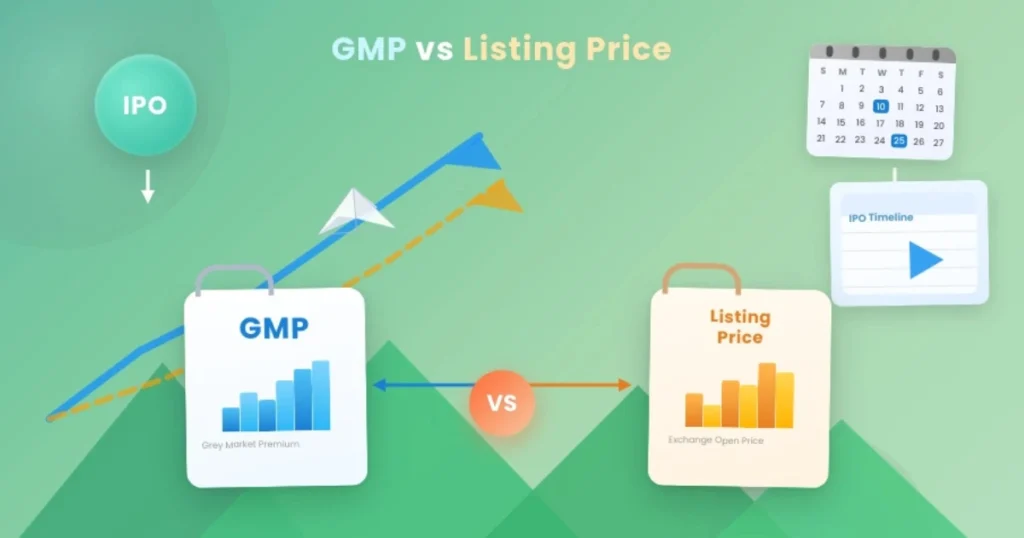
The Math: From Premium to Prediction
The calculation for expected gains is straightforward, but the interpretation requires nuance.
Expected Listing Price = Issue Price + GMP
For instance, the Innovision IPO (Issue Price: ₹548) recently saw its GMP fluctuate near ₹71, implying an 13% listing gain.
However, as the subscription was extended due to muted institutional demand, the GMP vs listing price narrative shifted, with the premium cooling off.
This highlights that GMP is a “live” sentiment barometer, not a fixed guarantee.
Performance Tracker: March 2026 Listing Accuracy
To see how well GMP vs listing price held up recently, look at these March 11–12, 2026 debuts:
| IPO Name | Issue Price | GMP Pre-Listing | Actual Listing Price | Listing Gain/Loss | Accuracy |
| SEDEMAC Mechatronics | ₹1,352 | ₹60 | ₹1,535 | +13.5% | Underestimated |
| Elfin Agro (SME) | ₹47 | ₹0 | ₹47.30 | +0.6% | Accurate |
| Acetech E-Commerce | ₹112 | ₹12 | ₹136 | +21% | Underestimated |
| Omnitech Engineering | ₹227 | -₹8 | ₹204 | -10% | Accurate |
[Image comparing a green rising GMP line chart against a fluctuating blue Listing Price bar graph for 2026 IPOs]
Why the Gap Exists in 2026
The discrepancy in GMP vs listing price is often driven by three “invisible” market factors:
- The QIB Effect: Institutional investors (QIBs) often place their bids on the final hour of the final day. If the QIB portion is oversubscribed by 100x, the GMP vs listing price gap often explodes on listing morning, far exceeding the initial grey market estimates.
- Market Volatility (VIX): In March 2026, geopolitical tensions in West Asia have kept the India VIX high. A sudden 200-point drop in the Nifty 50 can wipe out a 15% GMP overnight, leading to a “discount listing” despite positive unofficial sentiment.
- Grey Market Manipulation: Because the grey market is unregulated, large operators sometimes “pump” the GMP to attract retail applications. Smart investors always cross-verify GMP vs listing price expectations with the company’s P/E ratio and debt-to-equity levels.
SEBI’s 2026 Guidelines on Price Discovery
Effective early 2026, SEBI has tightened the Pre-Open Call Auction rules to ensure the GMP vs listing price deviation is driven by transparent supply and demand rather than speculative spikes.
The exchange now uses a “Random Closure” mechanism for the pre-open session, making it harder for high-frequency traders to manipulate the opening price at the last second.
Also read: Auto Sector Skids: Why Nifty Auto Crashed 3% as Crude Reclaims $100
Final Strategy for Retail Investors
If you are using GMP vs listing price to decide your subscription strategy:
- Look for Consistency: A GMP that remains stable or rises as the subscription dates approach is a stronger signal than a one-day spike.
- The 20% Rule: Historically, IPOs with a GMP of 20% or higher tend to list in the green, even if the actual listing price varies from the estimate.
- Focus on Fundamentals: Remember that while GMP vs listing price determines your Day 1 profit, it has no bearing on the stock’s performance six months later.
Disclaimer: The views expressed are for informational purposes only and do not constitute financial advice. Investing in stocks and IPOs involves significant risk.
forgeup.in is not liable for any financial losses. Always consult a certified investment advisor before making any decisions.