
Fundamental Analysis of IRFC: Indian Railway Finance Corporation (IRFC) is the dedicated market borrowing arm of the Indian Railways. As of May 11, 2026, the company has successfully transitioned from a steady “fixed-income proxy” to a cornerstone of India’s infrastructure boom. With a record-breaking Railway Capex of ₹2.93 lakh crore in the Union Budget 2026-27, IRFC stands as the primary beneficiary of the government’s ambitious multi-modal and high-speed rail transformation.
In the May 2026 market, IRFC is trading in a consolidation zone following a significant Offer for Sale (OFS) in February. While the stock has seen a temporary pullback to ₹103–₹106 from its June 2025 highs, its fundamentals—characterized by a zero-NPA history and a low-risk lease model—remain some of the strongest in the PSU financial sector.
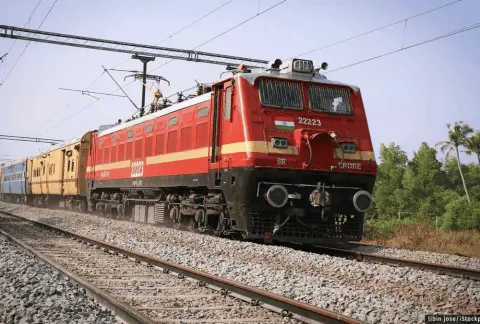
Fundamental Analysis of IRFC: Is India’s Railway Financier a Smart Buy at ₹103 in May 2026?
Business Strategy: Financing India’s “Diamond Triangle”
IRFC’s strategy is intrinsically linked to the Ministry of Railways’ expansion plans. It primarily raises funds from capital markets to acquire rolling stock assets (wagons, locomotives, coaches) which are then leased to the Railways.
A. Record Capex Momentum
- Budget 2026-27: The government allocated a record ₹2,93,030 crore for Indian Railways, a 10.25% increase over the previous year. This funding is earmarked for 4,000 km of high-speed rail corridors, the “Kavach” safety system, and the redevelopment of stations.
- South High-Speed Triangle: IRFC is the key financier for the new “South Triangle” high-speed network connecting Chennai, Bengaluru, and Hyderabad, a project estimated to attract over ₹16 lakh crore in long-term investment.
B. Asset-Light & Zero-Risk Model
IRFC follows a “Cost-Plus” model. All its assets are leased to the Ministry of Railways, ensuring zero Non-Performing Assets (NPAs). The company acts essentially as a financial pass-through with a guaranteed margin, making it one of the safest credit profiles in India.
Fundamental Analysis of IRFC: Financial Snapshot: FY26 Analysis (May 2026)
As of May 11, 2026, investors are anticipating the Q4 FY26 results, scheduled for announcement on May 14, 2026.
| Metric | Value (As of May 11, 2026) | Trend |
| Current Market Price (CMP) | ₹103.65 – ₹106.27 | Consolidating |
| Market Capitalization | ~₹1.38 Lakh Crore | Large-Cap PSU |
| Trailing P/E Ratio | ~19.79x | Fairly Valued |
| Return on Equity (ROE) | ~12.77% | Stable |
| Dividend Yield | ~1.51% | Consistent Payout |
| Net Profit (TTM) | ~₹7,011 Crore | Steady Growth |
B. Recent Earnings Trajectory
- Q3 FY26 Performance: Reported a net profit of ₹1,802 crore, maintaining its trajectory of steady incremental growth.
- Dividend Updates: The company recently declared an interim dividend of ₹1.05 per share in March 2026, consistent with its policy of distributing nearly 30% of its annual profits.
The OFS Factor: Supply Overhang and Valuation
A major event in 2026 was the government’s 4% stake sale (Offer for Sale) in February 2026 at a floor price of ₹104.
- The Goal: To move toward SEBI’s 75% public shareholding norm. The promoter (Government of India) stake currently stands at ~84.65%.
- Market Impact: The OFS created a “supply overhang,” keeping the stock price under pressure in early May. However, analysts view this as a “Value Zone” entry point, as it improves the stock’s liquidity and inclusion in global indices.
Fundamental Analysis of IRFC: Fundamental Moats and Strengths
- Sovereign Guarantee: As a 100% government-backed entity (functionally), IRFC enjoys the highest credit ratings (AAA/A1+), allowing it to borrow funds at significantly lower rates than private NBFCs.
- Operational Efficiency: With only a handful of employees and almost no physical infrastructure of its own, IRFC has an EBITDA margin of ~99% and exceptionally low operating costs.
- Inflation Hedge: The lease agreements include clauses that protect against interest rate volatility, ensuring the bank’s margins are preserved regardless of macro shifts.
Also read about Fundamental Analysis of Infosys
Risks and Headwinds: The 2026 Bear Case
- Policy Concentration: IRFC has only one client—the Indian Railways. Any shift in government policy toward “Extra Budgetary Resources” (EBR) could reduce IRFC’s business volume.
- Dividend Yield vs. Growth: While IRFC is a steady compounder, it lacks the high-beta growth seen in “Railway EPC” stocks like RVNL or IRCON. It is more of a “yield play” than a “momentum play.”
- Rate Sensitivity: As a financier, its spreads are sensitive to the RBI’s repo rate movements. Any prolonged “High for Longer” rate cycle in late 2026 could marginally compress its Net Interest Margins (NIMs).
Frequently Asked Questions(FAQ)
Why is IRFC’s share price falling in May 2026?
The price is under pressure primarily due to the supply overhang from the February 2026 OFS and broader macro headwinds like rising global bond yields and Middle East geopolitical tensions impacting rate-sensitive financials.
When is the IRFC Q4 FY26 result date?
The Board of Directors is scheduled to meet on May 14, 2026, to consider and approve the audited financial results for the year ended March 31, 2026, and recommend a final dividend.
What is the government’s current stake in IRFC?
As of May 2026, the Government of India holds 84.65% stake. It needs to dilute another ~9.65% in the future to comply with SEBI’s 25% minimum public shareholding (MPS) rule.
Conclusion
Is IRFC a PSU with massive growth potential? The verdict is “Yes,” but with a 3–5 year horizon. In May 2026, the stock is priced attractively at ₹103–₹105, near its OFS floor price. With the May 14 Board Meeting expected to approve the final dividend and confirm FY26 audited results, the current consolidation offers a strategic entry point.
While it may not see the 400% “meme-stock” rallies of 2023, its role in financing a ₹16 lakh crore high-speed rail corridor ensures that IRFC will remain a dominant, low-risk infrastructure compounder for the next decade. Analysts project a recovery toward the ₹140–₹160 range as the OFS supply is absorbed by institutional investors.
Disclaimer: The views expressed are for informational purposes only and do not constitute financial advice. Investing in stocks and IPOs involves significant risk.
forgeup.in is not liable for any financial losses. Always consult a certified investment advisor before making any decisions.