
Fundamental Analysis of Adani Green Energy: Adani Green Energy Limited (AGEL), the renewable energy flagship of the Adani Group, has solidified its position as India’s largest and one of the world’s most aggressively scaling pure-play renewable energy utilities. As of May, 2026, the company has entered a high-growth operational phase, transitioning massive under-construction capacities into active revenue-generating assets. Fueled by India’s national target of achieving 500 GW of non-fossil fuel capacity, AGEL reported a landmark fiscal year 2026, driven by record greenfield capacity commissions.
In the stock market sessions around May 18, 2026, AGEL is trading at approximately ₹1,364–₹1,369, recovering robustly from its mid-year lows. Supported by a comprehensive promoter warrant conversion that injected significant equity capital, the stock continues to command a distinct growth premium.
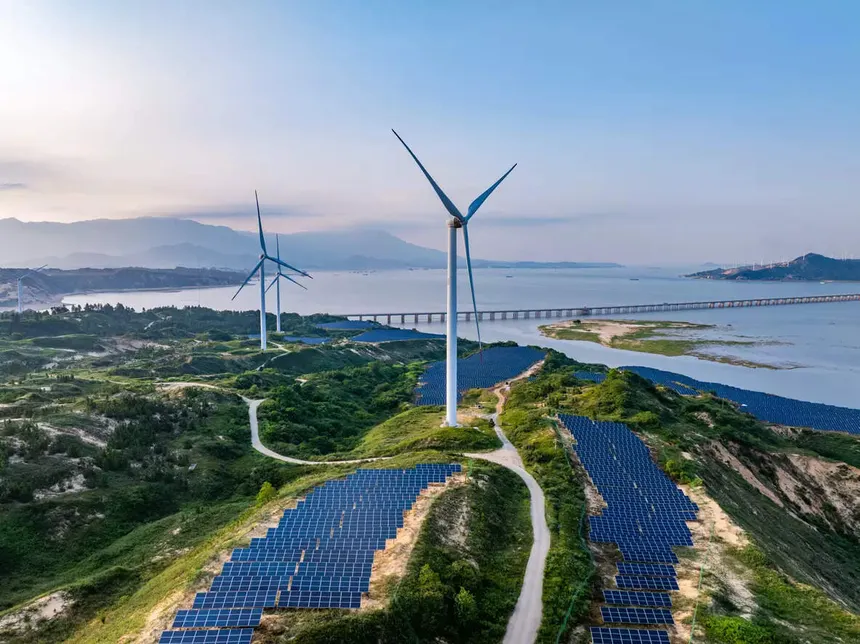
Fundamental Analysis of Adani Green Energy: Financial Performance, Khavda Mega Project, 91% EBITDA Margin & Strategic Outlook
Financial Performance: Landmark FY26 Capacity Monetization
The Q4 FY26 audited financial results (announced April 24, 2026) showcased a powerful surge in revenue from power supply and so structural operating profits, reflecting severe operating leverage as scale expands.
A. Key Financial Metrics (Consolidated)
| Metric | Q4 FY26 (Actual) | Trend (YoY) | FY26 Full Year | Trend (YoY) |
| Total Income | ₹3,727 Crore | ▲ 13.7% | ₹13,819 Crore | ▲ 11.2% |
| Revenue from Power Supply | ₹3,094 Crore | ▲ 16.0% | ₹11,602 Crore | ▲ 22.0% |
| EBITDA from Power Supply | ₹2,944 Crore | ▲ 20.0% | ₹10,865 Crore | ▲ 23.0% |
| EBITDA Margin (%) | 91.0% | Stable | 91.0% | Industry-leading |
| Net Profit (PAT) | ₹397 Crore | ▲ 72.6% | ₹1,652 Crore | ▲ 14.4% |
B. Warrant Conversion & Balance Sheet Injection
A critical corporate governance and balance sheet event occurred in late FY26. AGEL fully converted over 6.31 crore warrants issued to the Promoter Group on a preferential basis, successfully raising ₹9,350 crore in pure equity. This capital injection significantly strengthens the bank’s net worth, increases the paid-up equity share capital to ₹1,647 crore, and acts as a massive de-leveraging tool to lower its net-debt-to-EBITDA ratio.
Fundamental Analysis of Adani Green Energy: Operational Capacity – The Greenfield Execution Moat
AGEL’s structural advantage is its rapid greenfield commissioning speed. Thus in FY26, the company achieved an execution milestone unmatched by any global pure-play developer outside of China.
- Total Operational Capacity: Reached 19,294 MW (19.3 GW) as of March 31, 2026, marking a powerful 35% YoY expansion from 14,243 MW in FY25.
- Record Annual Capacity Addition: Commissioned a staggering 5,051 MW (5.1 GW) of greenfield capacity during the single fiscal year.
- The Khavda Flagship Monster: AGEL’s mega-project in Khavda, Gujarat (spanning an area 5 times the size of Paris), so it has 9.4 GW already fully operational across a balanced blend of solar, wind, and solar-wind hybrid projects.
- Energy Sales Volume: Surged 34% YoY to 37,567 million units in FY26, with power purchase agreement (PPA) deliveries tracking at 106% of annual contractual commitments.
Fundamental Moats and Strengths
1. Long-Term PPA-Backed Cash Flow Visibility
Almost 100% of AGEL’s operational portfolio is locked into long-term Power Purchase Agreements (PPAs) with central counterparties like SECI, NTPC, and high-rated state distribution companies (DISCOMs). Therefore average PPA tenures stretching to 25 years at fixed tariffs, the company has insulated its core revenue streams from spot merchant tariff volatility.
2. Best-in-Class Operating Profitability
AGEL maintains an industry-leading 91% EBITDA margin on power supply. Renewable assets require zero fuel inputs; therefore, once the massive initial capital expenditures are deployed and lines are synchronized, the ongoing operational costs are exceptionally low, channeling top-line revenue directly into cash profits.
3. Grid-Balancing Battery Frontier
To counteract the natural intermittency of wind and solar generation, AGEL deployed a massive 1,376 MWh Battery Energy Storage System (BESS) at Khavda. Management plans to aggressively scale this storage footprint to over 10,000 MWh by FY27, thus anchoring its transition from an intermittent power generator to a premium provider of dispatchable round-the-clock (RTC) green power.
Key Risks and Headwinds: The Bear Case
- Elevated Valuation Multiples: Trading at a trailing P/E ratio exceeding 140x and a P/B of ~11.3x, AGEL continues to demand an extreme growth premium. Because its valuation structure is priced to absolute execution perfection, any localized delays in executing its 2030 targets can provoke severe short-term stock volatility.
- Persistent Leverage Realities: While the ₹9,350 crore promoter capital injection provided an excellent buffer, building out an additional 30 GW of capacity remains incredibly capital-intensive. Sustained high global interest rates could keep the cost of debt refinancing elevated across its international bond structures.
- Grid Evacuation Overhang: Greenfield capacity execution means very little if inter-state transmission lines experience synchronization bottlenecks. AGEL remains structurally dependent on public sector lines to move its massive Khavda power generation to cross-national load centers.
Fundamental Analysis of Adani Green Energy: Valuation & Market Outlook (May 2026)
| Parameter | Market Value (As of May 18, 2026) | Valuation Context |
| Current Market Price (CMP) | ₹1,364.00 – ₹1,369.00 | Stabilizing post-earnings |
| Trailing P/E Ratio | ~141.3x | Premium growth play |
| Price-to-Book (P/B) Ratio | 11.32x | Reflects rich asset base |
| Market Capitalization | ~₹2.22 Lakh Crore | India’s largest listed green utility |
| Analyst Consensus Target | ₹1,400.00 – ₹1,450.00 | Healthy upside projection |
Frequently Asked Questions
What caused Adani Green’s Q4 FY26 net profit to spike by 72%?
The surge was driven primarily by a 35% YoY increase in operational capacity, which scaled to 19.3 GW. New project commissionings began contributing full-quarter revenue and cash profits, keeping overall operational EBITDA margins stable at 91%.
What is the purpose of the recent ₹9,350 crore equity raise?
The capital was raised through the full conversion of preferential warrants held by the Promoter Group. The funds are earmarked for partially de-leveraging the balance sheet and directly funding the heavy Capex pipeline required for the Khavda expansion phase.
Is Adani Green a dividend-paying stock in 2026?
No, AGEL does not traditionally offer material dividend yields. In alignment with its aggressive growth footprint, almost 100% of accumulated cash profits and free cash flow are instantly reinvested back into project capital expenditure to finance its 50 GW path.
Conclusion
Fundamentally, Adani Green Energy in May 2026 is a “High-Beta Core Infrastructure Asset.” It is categorically unsuitable for value purists or low-risk income portfolios seeking near-term dividend yields. However, for growth-oriented institutions and structural ESG mandates, AGEL’s milestone execution of adding 5.1 GW of greenfield capacity in a single year proves that its operational engine is firing on all cylinders.
With its balance sheet de-risked via promoter equity infusions and its operational asset base tracking closely toward its 50 GW target by 2030, the current stock price offers an excellent structural long-term entry point for investors wanting pure-play exposure to India’s energy transition.
Disclaimer: The views expressed are for informational purposes only and do not constitute financial advice. Investing in stocks and IPOs involves significant risk.
forgeup.in is not liable for any financial losses. Always consult a certified investment advisor before making any decisions.