
The Indian equity market continues to attract millions of new retail participants. One of the most frequent points of confusion for investors is seeing a stock like Infosys trading at roughly ₹1,400 while its Face Value is stated as just ₹5. These two numbers represent the same piece of the company but serve entirely different masters: one belongs to the world of Accounting, and the other to the world of Trading.
Understanding the face value vs market value relationship is crucial because it dictates how much cash you actually receive when a company “declares a 400% dividend.” If you calculate that 400% on the market price, your math will be dangerously wrong. This guide provides an in-depth breakdown of these metrics in the current 2026 financial landscape.
What Is Face Value vs Market Value of a Share in India?
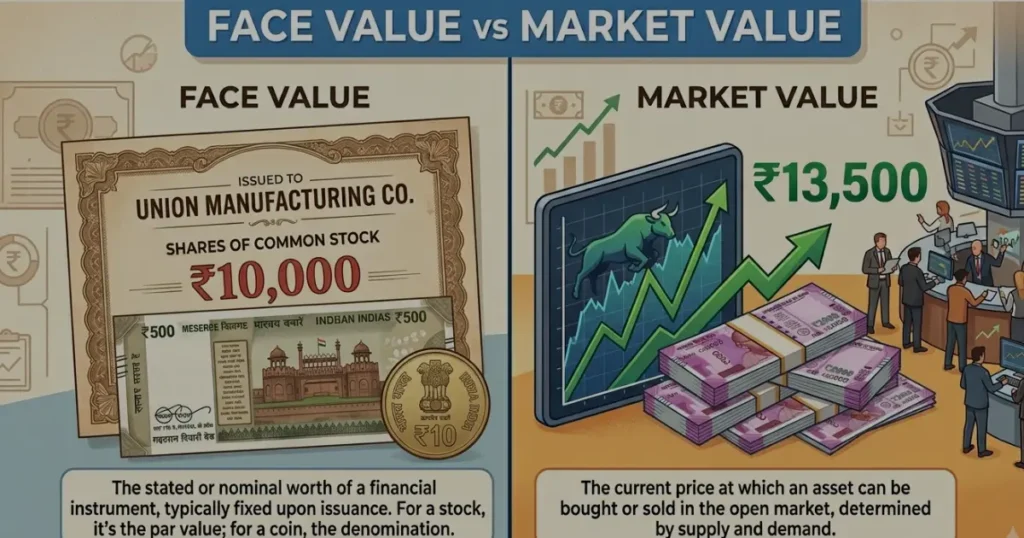
What is the Face Value of a Share? (The Accounting Anchor)
Face Value (also known as Par Value or Nominal Value) is the “Official” price of a share assigned by the company founders during incorporation. It is the value recorded in the company’s books and printed on the share certificate.
- Set by the Company: It is an arbitrary number (usually ₹1, ₹2, ₹5, or ₹10) chosen when the company is born.
- Static Nature: It does not change based on news, profits, or losses. It only changes during corporate actions like a Stock Split.
- Accounting Foundation: Total Share Capital = Total Shares × Face Value. Any amount received above this during an IPO is recorded as “Securities Premium.”
What is the Market Value of a Share? (The Investor’s Reality)
Market Value is the “Real-Time” price at which a share is currently trading on the stock exchanges (NSE/BSE). This is the price you see flickering on your broker app like Zerodha or Groww.
- Set by the Market: It is driven entirely by Demand and Supply. If more people want to buy the stock than sell it, the market value goes up.
- Dynamic Nature: It fluctuates every second. In 2026, factors like global interest rates, geopolitical tensions in the Middle East, and quarterly earnings cause constant movement.
- Future-Looking: While face value looks at the company’s past (incorporation), market value looks at the company’s Future Potential.
Direct Comparison: Face Value vs. Market Value
To simplify this for the layman investor, here is a side-by-side breakdown of the core differences:
| Basis of Difference | Face Value (Nominal Value) | Market Value (Trading Price) |
| Determination | Decided by the Company/Board | Determined by Demand and Supply |
| Stability | Remains constant (unless split) | Fluctuates every single second |
| Purpose | Accounting, Dividends, Legal | Trading, Profits, Net Worth |
| Usage | Calculating Share Capital | Valuing your Portfolio |
| Relation to Worth | Zero relation to current success | Direct reflection of company performance |
Why Do Companies Declare Dividends on Face Value?
This is the biggest “Trap” for new investors. Under Indian corporate law, dividends are always announced as a percentage of the Face Value, not the market price.
The Math Example (2026):
Suppose you own shares of a company with a Face Value of ₹10 and a Market Price of ₹1,000. The company announces a “100% Dividend.”
- The Layman’s Mistake: Expecting ₹1,000 per share.
- The Reality: You get 100% of the ₹10 Face Value = ₹10 per share.
- The Yield: Your actual “Dividend Yield” is only 1% (₹10 / ₹1,000).
How Does a Stock Split Change Both Values?
In 2026, many high-priced stocks perform “Stock Splits” to make shares more affordable for retail investors. This is the only event where the face value vs market value both shift simultaneously.
- The Trigger: A stock trading at ₹2,000 with a Face Value of ₹10 undergoes a 1:2 Split.
- Face Value Change: The new Face Value becomes ₹5 ($10 / 2$).
- Market Value Adjustment: The exchange automatically adjusts the trading price to roughly ₹1,000 ($2,000 / 2$).
- Portfolio Impact: You now have 2 shares instead of 1, but your total investment value remains unchanged.
Can the Market Value Fall Below the Face Value?
Yes. While healthy companies trade at 10x or 100x their face value, “Penny Stocks” or fundamentally weak companies can fall below their par value.
- The Warning Signal: If a stock with a face value of ₹10 is trading at ₹7 in the market, it is a massive red flag. It suggests the market believes the company’s assets are worth less than its original accounting value.
- Regulatory Issues: In 2026, SEBI has stricter monitoring for stocks trading below face value to prevent “Shell Company” manipulations.
5-Point Checklist for Distinguishing Share Values
- Check the App: Look for the “FV” (Face Value) tag in your stock’s fundamental data section.
- Calculate the Premium: The difference between the current price and face value tells you how much “Future Growth” you are paying for.
- Don’t Fall for Headlines: When you see “500% Dividend,” immediately look for the face value to find the real rupee amount.
- Monitor the Split Ratio: If you see a face value of ₹1, know that the stock cannot be split further (as ₹1 is the minimum legal limit in India).
- Focus on Market Cap: Market Capitalization = Total Shares × Market Value. This is the true size of the company, not its share capital.
Also read about Indian Shipbuilding Stocks
Final Thoughts: Two Numbers, One Goal
The face value vs market value debate is a classic example of “Price vs. Value.” The face value is a formal accounting requirement, while the market value is the reality of your wealth.
For the community, the strategy is clear: Use the face value to calculate your passive dividend income, but use the market value to track your capital appreciation.
Mastering both ensures you never get misled by corporate headlines again.
FAQ on Face Value vs Market Value 2026
1. Is a higher Face Value better for an investor?
No. A higher face value (like ₹10 vs ₹1) does not mean the company is better. It is purely an accounting choice. In fact, many modern tech companies prefer a lower face value (₹1) to avoid the need for stock splits later.
2. Where can I find the face value of any listed Indian stock?
You can find it on the official NSE or BSE websites under the “Corporate Information” tab for any specific stock. Most broker apps also list it under the “Fundamentals” or “Company Profile” section.
3. Does the Face Value change when I sell my shares?
No. When you sell, you receive the Market Value. The face value remains fixed in the company’s records regardless of how many times the share changes hands between investors.
4. Can a company change its face value without a stock split?
No. The only way to change the face value is through a formal corporate action like a Stock Split (division) or a Reverse Split / Consolidation (merging shares), both of which require shareholder and regulatory approval.
Disclaimer: The views expressed are for informational purposes only and do not constitute financial advice. Investing in stocks and IPOs involves significant risk.
forgeup.in is not liable for any financial losses. Always consult a certified investment advisor before making any decisions.