
The Indian stock market has crossed the $5.5 trillion valuation mark, driven by a surge in retail participation. For investors, entering the market without understanding the “Three Prices” of a stock is like flying a plane without an altimeter. While most beginners only look at the flickering numbers on their broker app, professional investors use the interplay between Book Value, Face Value, and Market Value to find undervalued gems and avoid “Value Traps.”
Every share of a company—whether it’s a giant like Reliance or a fresh IPO like Powerica—carries these three distinct valuations. One represents the company’s past (Face Value), one represents its present assets (Book Value), and one represents its future potential (Market Value).
Book Value vs Face Value vs Market Value Guide: Explained
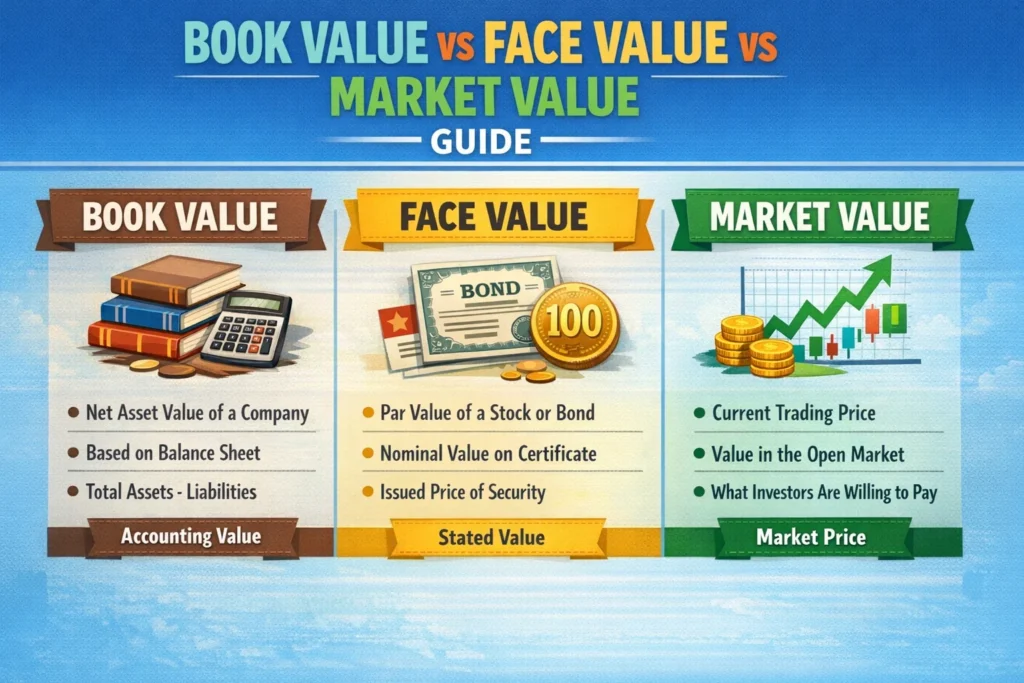
1. Face Value: The Accounting Anchor
Face Value (also known as Par Value) is the “Official” price of a share assigned by the company founders during its incorporation. It is the value recorded in the company’s legal books and printed on the original share certificates.
- Why it exists: It is a legal requirement for calculating the “Paid-up Share Capital.”
- The Dividend Rule: In 2026, companies still declare dividends as a percentage of the Face Value. If a stock has a Face Value of ₹10 and declares a “100% Dividend,” you get ₹10 per share, regardless of whether the stock is trading at ₹500 or ₹5,000.
- Corporate Actions: Face Value only changes during a Stock Split (e.g., a ₹10 share becoming two ₹5 shares).
2. Book Value: The “Exit” Value
Book Value represents the “Net Worth” of the company according to its balance sheet. It is what shareholders would theoretically receive if the company stopped operations today, sold every asset (factories, land, cash), and paid off every debt.
- The Calculation: (Total Assets – Total Liabilities) / Total Number of Shares.
- The “Margin of Safety”: Value investors look for stocks where the Market Price is close to or below the Book Value. This suggests you are buying the company for the price of its physical assets alone, with its future growth coming “for free.”
- Sector Dependency: Book Value is critical for Banks and Manufacturing firms but less relevant for IT or AI startups like Sarvam AI, where the value lies in “Human Capital” rather than physical buildings.
3. Market Value: The Psychological Price
Market Value is the “Real-Time” price you see on the NSE or BSE. It is driven entirely by Demand and Supply and reflects the collective wisdom (and emotions) of millions of investors.
- Forward-Looking: Unlike Book Value (which looks at the past), Market Value looks at Future Profits. This is why a tech company might have a Book Value of ₹50 but a Market Value of ₹1,000—investors are paying a premium for future innovation.
- Volatility: It changes every second based on news, geopolitical shifts in early 2026, and quarterly earnings reports.
Direct Comparison: The Three Value Matrix
| Feature | Face Value | Book Value | Market Value |
| Source | Company Charter | Balance Sheet | Stock Exchange |
| Stability | Static (Fixed) | Quarterly Updates | Real-time Fluctuation |
| Determined By | Founders/Board | Accounting Assets | Market Sentiment |
| Primary Use | Dividends & Splits | Safety & Valuation | Trading & Net Worth |
| Typical Range | ₹1, ₹2, ₹5, ₹10 | Varies by Assets | Varies by Demand |
How Do These Values Interact in 2026?
In the current April 2026 market, the relationship between these three numbers tells a story about the stock’s health.
The “Overvalued” Scenario (P/B > 5.0)
If a stock has a Face Value of ₹1, a Book Value of ₹100, and a Market Value of ₹1,500, it is trading at 15 times its book value. This is common in “High-Growth” sectors like Green Hydrogen or AI. Investors should be cautious; if the growth slows down, the market value will crash toward the book value.
The “Value” Scenario (P/B < 1.0)
If a stock has a Face Value of ₹10, a Book Value of ₹400, and a Market Value of ₹350, it is selling for less than its assets. This often happens in PSU Banks or old-school infrastructure companies. While it looks like a bargain, check for “Bad Debts”—sometimes the book value is high because the company hasn’t written off old, useless machinery.
Which Value Matters Most for a Retail Investor?
For the market participants, the answer depends on your goal:
- For Income Seekers: Face Value is king. You want to know the Face Value to calculate your actual dividend payout. A high percentage dividend on a low Face Value might be less attractive than a lower percentage on a high Face Value.
- For Conservative Investors: Book Value is the anchor. You want to ensure you aren’t paying a “Bubble Price” that is 50x higher than what the company actually owns.
- For Active Traders: Market Value is the only reality. You buy and sell based on price action and momentum, often ignoring the “Accounting” values entirely.
How Does a Stock Split Affect All Three?
When a company like Reliance announces a 1:2 Stock Split in 2026:
- Face Value: Is halved (e.g., ₹10 becomes ₹5).
- Market Value: Is roughly halved (e.g., ₹3,000 becomes ₹1,500).
- Book Value: Is also halved per share, but since you now own two shares instead of one, your total “Book Wealth” remains identical.
5-Point Checklist for Comparing Share Values
- Identify the “Premium”: Subtract the Book Value from the Market Value. This “Gap” is what you are paying for the company’s brand and future.
- Check the P/B Ratio: Divide Market Price by Book Value. In 2026, a P/B between 1.5 and 3.0 is generally considered healthy for the Nifty 50.
- Verify Dividend Yield: Divide the (Dividend % × Face Value) by the Market Price. If the yield is above 5%, it’s a strong income stock.
- Watch for “Hidden” Assets: Sometimes a company’s Book Value is low because its land holdings (purchased in 1970) are recorded at original cost, not 2026 market rates.
- Avoid “Negative” Book Value: If a company’s liabilities exceed its assets, the Book Value is negative. In the 2026 regulatory environment, these are “High Risk” stocks prone to delisting.
Also read about Rain Industries Share Price
Final Thoughts: The Trinity of Valuation
Mastering the book value vs face value vs market value relationship transforms you from a “Speculator” into an “Investor.” While the market value provides the excitement, the face value provides the income, and the book value provides the safety.
As an investor, we believe that the best investments are found where the market value is rising, the book value is solid, and the face value allows for consistent dividend rewards.
FAQ on Share Valuations 2026
1. Can a company change its Face Value without a stock split?
No. In India, the Face Value can only be altered through formal corporate actions like a Stock Split (reduction) or Consolidation (increase), both of which require SEBI and shareholder approval.
2. Why is Book Value per share different in every app?
Different apps use different “Net Worth” definitions. Some include “Intangible Assets” (like Goodwill), while others use “Tangible Book Value,” which only counts physical assets. Always refer to the company’s official “Annual Report 2025-26” for the most accurate figure.
3. Does a high Face Value mean a company is “Stronger”?
Not at all. A ₹100 face value and a ₹1 face value are just accounting choices. In fact, most modern companies prefer a ₹1 face value to ensure their shares remain “Liquid” and affordable for retail investors.
4. What is the “Intrinsic Value”? Is it the same as Book Value?
No. Intrinsic Value is a calculated estimate of what a stock is actually worth based on future cash flows. It is a subjective number, whereas Book Value is a factual accounting number based on current assets.
Disclaimer: The views expressed are for informational purposes only and do not constitute financial advice. Investing in stocks and IPOs involves significant risk.
forgeup.in is not liable for any financial losses. Always consult a certified investment advisor before making any decisions.