
The Big Private Space Milestone
India’s premier space technology startup, Skyroot Aerospace Private Limited, successfully executed the maiden test flight of “Vikram-1,” the nation’s first privately developed orbital-class rocket, Saturday, July 18, 2026. Dropping into a precise countdown at the Satish Dhawan Space Centre in Sriharikota, the “Mission Aagaman” flight successfully lifted off at 11:35 AM IST, carrying multiple commercial and experimental payloads into low-Earth orbit (LEO).
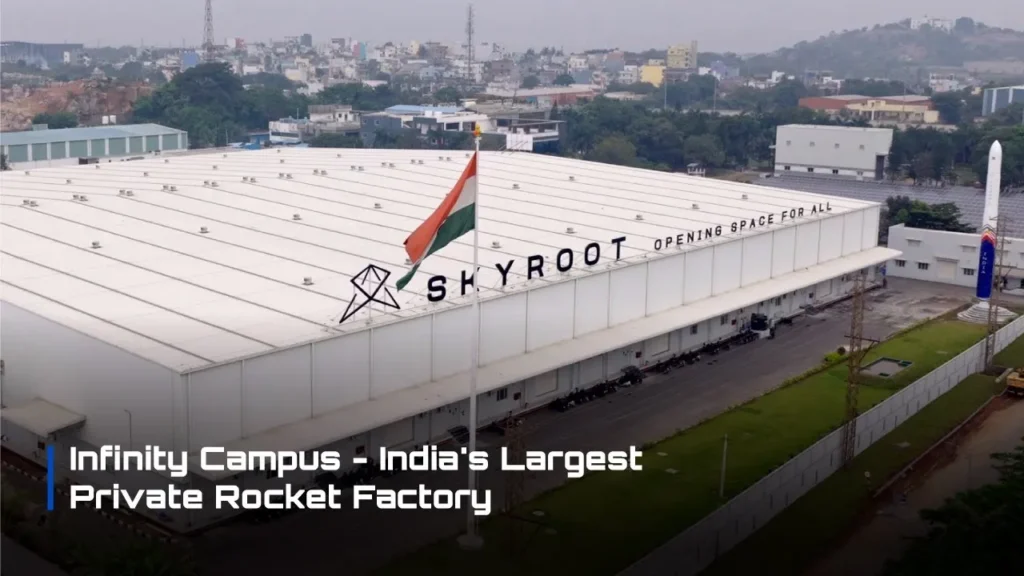
While Skyroot itself remains an unlisted company, the successful Vikram-1 mission could increase investor interest in India’s listed aerospace, defence, and precision engineering companies. Market participants may closely monitor businesses associated with the broader space ecosystem as India’s commercial launch industry continues to expand. Earlier in May 2026, the Hyderabad-based startup officially entered the elite Unicorn Club with a private market valuation crossing $1.1 Billion (₹10,600 Crore), underscoring intense capital backing for India’s liberalized space ecosystem.
Quick Highlights: The Strategic Space Launch Metrics
- Launch Date: Saturday, July 18, 2026.
- Mission Name: “Mission Aagaman” (First private orbital test flight).
- Vehicle Architecture: A 22-meter-tall, three-stage launch vehicle built using carbon-composite structures. Vikram-1 incorporates 3D-printed propulsion technology and is designed to place payloads of up to 350 kg into Low Earth Orbit (LEO).
- Revenue Roadmap: According to the company’s previously disclosed financial projections, Skyroot has outlined a revenue target of approximately ₹977 crore by FY27 and a longer-term aspiration of ₹13,000 crore by FY32. These figures are management projections and remain subject to execution and market conditions.
- Listed Stock Watch: Investors may keep companies operating across aerospace manufacturing, propulsion systems, defence electronics, and precision engineering on their watchlists as India’s private space industry evolves.
Companies That Investors May Watch Following Skyroot’s Milestone
Although Skyroot is not publicly listed, investors often look at established listed companies operating within India’s aerospace and defence ecosystem when evaluating potential indirect beneficiaries of major industry developments. Whether these companies benefit financially will depend on future order inflows, commercial partnerships, and execution.
| Company Name | Ticker (NSE) | Role in the Space/Defense Ecosystem | Why Investors May Watch |
| Azad Engineering | AZAD | Supplies highly engineered precision blades, actuators, and mission-critical components. | Precision engineering capabilities aligned with aerospace applications. |
| MTAR Technologies | MTARTECH | High-precision engineering partner; manufactures liquid propulsion components and engine parts. | Manufactures high-precision propulsion and engineering components used across strategic sectors. |
| Data Patterns | DATAPATTNS | Fabricates advanced space electronics, radar processing systems, and specialized avionics modules. | Develops advanced electronics, avionics, and defence systems. |
| Bharat Electronics | BEL | State-run defense electronics giant providing tracking telemetry and strategic payload components. | Leading defence electronics company that could benefit from India’s expanding aerospace ecosystem. |
Why It Matters: The “Cab Service to Space” Commercial Moat
The successful deployment of Vikram-1 could strengthen investor interest in India’s emerging private space ecosystem and increase attention on companies operating across aerospace, propulsion, and defence technologies:
- Disrupting Global Small-Satellite Launch Rates: Vikram-1 is custom-built to ferry light payloads up to 350 kg into Low Earth Orbit. If Skyroot successfully scales commercial operations, its business model could evolve into an on-demand launch service for small satellites, a model often described as a “cab service to space.” Such a model may reduce waiting times for dedicated launches and improve flexibility for satellite operators.
- Growth Expectations Following Vikram-1: According to the company’s previously disclosed financial projections, Skyroot expects revenue to reach approximately ₹977 crore by FY27 and has outlined longer-term aspirations of around ₹13,000 crore by FY32. These are management projections and remain subject to execution, commercial demand, and market conditions.
- The IPO Horizon and Global Comparables: Following its unicorn valuation, some market observers believe Skyroot could become a potential IPO candidate over the coming years. However, the company has not announced any listing timeline, and any IPO expectations remain speculative. Some analysts have drawn comparisons between Skyroot and global commercial launch companies such as Rocket Lab USA, given their focus on the small-satellite launch market. However, Skyroot’s business model and growth trajectory remain at an early stage.
What It Means for Investors
From a stock market perspective, the Vikram-1 mission reinforces the long-term investment case for India’s growing private space ecosystem. While Skyroot itself is unavailable to public investors, listed companies operating across aerospace manufacturing, electronics, propulsion systems, and defence technologies could remain on investors’ radar if commercial launch activity accelerates. However, investors should evaluate valuations, order books, execution capability, and earnings growth before drawing long-term conclusions. Investors should look closely at execution capability and margin tracking on a quarterly basis before building massive long-term positions.
Frequently Asked Questions (FAQ)
1. Can I buy Skyroot Aerospace shares on the Indian stock market Today?
No. Skyroot Aerospace is currently a privately held startup backed by major global venture funds. While its valuation stands at $1.1 Billion, it is not yet listed on the NSE or BSE.
2. What is the significance of the Vikram-1 launch on July 18, 2026?
The Mission Aagaman launch marked India’s first successful orbital mission by a privately developed launch vehicle, representing a major milestone for the country’s commercial space sector.
3. Which listed stocks are the best proxies to play Skyroot’s success?
Investors often monitor companies operating in India’s aerospace, precision engineering, propulsion, and defence electronics sectors, including Azad Engineering, MTAR Technologies, Data Patterns, and Bharat Electronics, when assessing opportunities arising from growth in the domestic space ecosystem.
4. What are Skyroot’s long-term financial growth targets?
The space tech company has outlined a target of ₹977 crore in revenue by FY27 following the Vikram-1 validation, with plans to expand operations to achieve a top-line performance of ₹13,000 crore by FY32.
Note: The companies mentioned above are not confirmed direct beneficiaries of the Vikram-1 mission. They are discussed as potential proxy plays based on their presence in India’s aerospace, defence, and precision engineering ecosystem. Investors should conduct their own research before making investment decisions.
Conclusion
The successful Vikram-1 mission reinforces the growing momentum behind India’s private space industry. Although Skyroot remains privately held, the milestone could increase investor attention on listed companies operating across aerospace, defence, propulsion, and precision engineering. Whether these businesses ultimately benefit will depend on commercial partnerships, execution, industry demand, and the continued expansion of India’s space economy.
Disclaimer: The views expressed are for informational purposes only and do not constitute financial advice. Investing in stocks and IPOs involves significant risk. forgeup.in is not liable for any financial losses. Always consult a certified investment advisor before making any decisions.